Losing a baby tooth is a normal part of growing up. But what happens when your child loses one much earlier than expected?
Whether the tooth was lost because of a cavity, an accident, infection, or a dental extraction, parents often wonder if the empty space will cause problems later.
In some cases, a kids dentist may recommend a space maintainer for kids. This small dental appliance can help preserve the space needed for a permanent tooth to erupt properly.
But not every child who loses a baby tooth early needs one.
Here is what parents should know about space maintainers, why they may be recommended, and when to have your child’s smile evaluated.
What Is a Space Maintainer for Kids?
A space maintainer is a dental appliance designed to hold open the space left when a baby tooth is lost prematurely.
Baby teeth do more than help children chew and speak. They also help guide permanent teeth into their proper positions as the mouth develops.
When a baby tooth is lost too early, nearby teeth can sometimes move into the empty space. This may reduce the room available for the permanent tooth underneath.
A space maintainer helps keep that area open while your child’s permanent tooth continues developing.
Band-and-Loop Space Maintainer
A band-and-loop appliance is commonly used when a single baby molar has been lost prematurely.
A band fits around a neighboring tooth, while a loop extends across the space to help prevent nearby teeth from drifting into it.
The band-and-loop is one of the most common space maintainer for kids options used when a single baby molar is lost prematurely
How Do You Take Care of a Space Maintainer?
Good oral hygiene becomes especially important when your child has a dental appliance.
Help your child:
Space Maintainers for Kids in Santa Rosa, CA
If your child has lost a baby tooth early, Toothmate Kids Dental provides kids dental care for children in Santa Rosa and surrounding Sonoma County communities.
Our kids dental team can evaluate your child’s teeth and developing smile and determine whether a space maintainer may be appropriate.
Because every child’s dental development is different, the best treatment is the one based on your child’s individual needs.
What Is a Space Maintainer for Kids?

A space maintainer is a dental appliance designed to hold open the space left when a baby tooth is lost prematurely.
Baby teeth do more than help children chew and speak. They also help guide permanent teeth into their proper positions as the mouth develops.
When a baby tooth is lost too early, nearby teeth can sometimes move into the empty space. This may reduce the room available for the permanent tooth underneath.
A space maintainer helps keep that area open while your child’s permanent tooth continues developing.
Why Would a Child Lose a Baby Tooth Too Early?
Baby teeth normally fall out according to a natural schedule. However, premature tooth loss can happen for several reasons, including:- Severe tooth decay
- Dental infection
- A dental injury or accident
- A tooth that cannot be restored
- Certain developmental or dental conditions
- A dentist recommending extraction because of extensive damage
Does My Child Need a Space Maintainer?
Whether your child needs a space maintainer depends on several factors, including:- Which baby tooth was lost
- Your child’s age
- How long ago the tooth was lost
- How much space is currently available
- The position and development of the permanent tooth
- Your child’s overall dental development
- The condition of the surrounding teeth
- Whether the neighboring teeth are beginning to shift
What Happens If a Baby Tooth Is Lost Too Early?
When a baby tooth disappears before its normal time, the teeth next to the empty area may move. Depending on the situation, this can contribute to:- Loss of available space
- Crowding
- Changes in the eruption path of a permanent tooth
- Changes in the developing bite
What Are the Different Types of Space Maintainers?
There are several types of space-maintaining appliances used in children’s dentistry. The right option depends on your child’s age, the tooth that was lost, the location of the space, and the stage of dental development.Band-and-Loop Space Maintainer
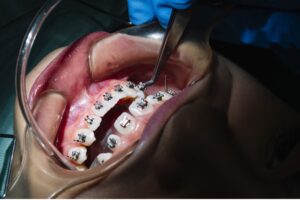
A band-and-loop appliance is commonly used when a single baby molar has been lost prematurely.
A band fits around a neighboring tooth, while a loop extends across the space to help prevent nearby teeth from drifting into it.
The band-and-loop is one of the most common space maintainer for kids options used when a single baby molar is lost prematurely
Distal Shoe Space Maintainer
A distal shoe may be considered in specific situations when a primary molar is lost before the permanent first molar has erupted. Because this appliance has a different design and requires careful monitoring, your kids dentist will determine whether it is appropriate.Lingual Holding Arch
A lingual holding arch is generally used when more than one lower primary tooth has been lost and maintaining the overall space is important.Transpalatal or Nance Appliance
For certain upper-jaw situations, a transpalatal arch or Nance-type appliance may be considered. Your kids dentist will recommend the type of space maintainer based on your child’s individual dental development.Are Space Maintainers Painful?
Most children adjust to a space maintainer relatively quickly. There may be a short adjustment period while your child becomes accustomed to having an appliance in the mouth. Your kids dental team can explain what to expect and how to keep the appliance clean. If the appliance becomes loose, broken, uncomfortable, or irritating, contact your child’s dentist rather than attempting to repair or adjust it at home.How Do You Take Care of a Space Maintainer?
Good oral hygiene becomes especially important when your child has a dental appliance.
Help your child:
- Brush twice a day with fluoride toothpaste as recommended by their dentist.
- Clean carefully around the appliance and surrounding teeth.
- Avoid chewing very hard or sticky foods that could damage or loosen the appliance.
- Avoid pulling or playing with the appliance.
- Attend recommended follow-up appointments.
- Tell the dental office if the appliance becomes loose or uncomfortable.
How Long Does a Child Wear a Space Maintainer?
There is no single timeframe for every child. A space maintainer may remain in place until the permanent tooth is ready to erupt, but the timing depends on which tooth was lost and how the child’s teeth are developing. Your kids dentist will monitor the area during follow-up appointments and determine when the appliance is no longer needed.Can a Space Maintainer Prevent Braces?
A space maintainer is not a guarantee that your child will never need braces. Its purpose is to maintain appropriate space after premature tooth loss when your kids dentist determines that doing so is appropriate. Some children may still develop crowding or bite problems for other reasons. Genetics, jaw development, tooth size, eruption patterns, and other factors can all influence whether orthodontic treatment is eventually needed. The important benefit is that early evaluation gives your child’s dental team an opportunity to identify potential problems before they become more complicated.What Should I Do If My Child Just Lost a Baby Tooth?
If your child lost a baby tooth earlier than expected, don’t panic. First, determine whether the tooth was lost naturally or because of an accident. If the tooth was knocked out, your child should be evaluated promptly, especially if there was significant trauma, bleeding, swelling, or injury to other teeth. If the tooth was removed because of severe decay or infection, ask your kids dentist whether the space should be monitored or maintained. Even if your child feels completely fine, an evaluation can help determine whether the permanent tooth is developing normally and whether the surrounding teeth are beginning to move.When Should I Call a Kids Dentist?
Contact a kids dentist if your child:- Loses a baby tooth much earlier than expected
- Has a baby tooth removed because of severe decay
- Has a tooth knocked out during an accident
- Develops swelling or pain around the missing tooth
- Has difficulty chewing after tooth loss
- Has an appliance that becomes loose or broken
- Has a permanent tooth that appears to be erupting in an unusual position